PartAgent Agentic 3D Part Segmentation via Expert Integration and Closed-Loop Refinement

1 Hong Kong University of Science and Technology 2 Tencent 3 Hong Kong Polytechnic University 4 Sun Yat-sen University

Abstract

Segmenting a 3D object into semantically meaningful parts requires joint reasoning about geometric structure and semantic context. Pretrained 3D experts provide spatially grounded region proposals, while 2D experts provide semantic cues for identifying object parts. The challenge is to integrate these complementary capabilities into a framework that can both produce meaningful part segmentations and progressively refine them. We present PartAgent, a training-free agentic framework for 3D part segmentation built upon two complementary modules: (i) Structural–Semantic Expert Integration combines regions predicted by the 3D expert with multiview semantic evidence from the 2D expert through image-to-surface correspondences, constructing compositional part partitions at multiple granularities. (ii) Observation-Driven Closed-Loop Partition Refinement observes the current partition and its supporting evidence to select targeted inspection, evidence repair, composition, or reselection actions. It verifies proposed changes and uses the updated state and action outcomes to guide subsequent decisions. On PartObjaverse-Tiny-WT, PartAgent achieves 68.41 mIoU, outperforming the strongest competing method by 8.53 points. Across 3DCoMPaT200, PartNeXt, PartNetE, and PartObjaverse-Tiny, PartAgent achieves the highest mIoU on each dataset, averaging 69.36 across the four datasets, 7.28 points above the highest mean among competing methods. All code and results will be released.

How PartAgent works

Follow one tractor from 3D expert regions and 2D semantic masks to the initial partition. Then see what prompts the agent to inspect the rear wheel, regroup its regions, and verify the change.

Structural–Semantic Expert Integration

PartAgent uses image-to-surface correspondences to map multiview semantic evidence onto the 3D expert regions. On the tractor, the fender and part of the tire become distinct integrated leaves within one such region. The mask tree records groupings of leaves. A vision–language model (VLM) proposes additional groupings in a directed acyclic graph (DAG). From these groups, PartAgent builds candidate partitions at multiple granularities. The VLM compares their projections with the original renders and semantic evidence to select the initial partition.

Observation-Driven Closed-Loop Partition Refinement

The VLM observes the current partition alongside the geometry, leaf IDs, and 2D masks in the same views. On the tractor, Inspect returns a closer view of the rear wheel. The fender and tire share a region, while the wheel is split in two. The agent chooses Compose to regroup the existing leaves. A separate VLM call checks the current partition and the proposal against the original renders. Once the change is accepted, the updated state and verification feedback guide the next inspection of the exhaust.

Explore the segmentations in 3D

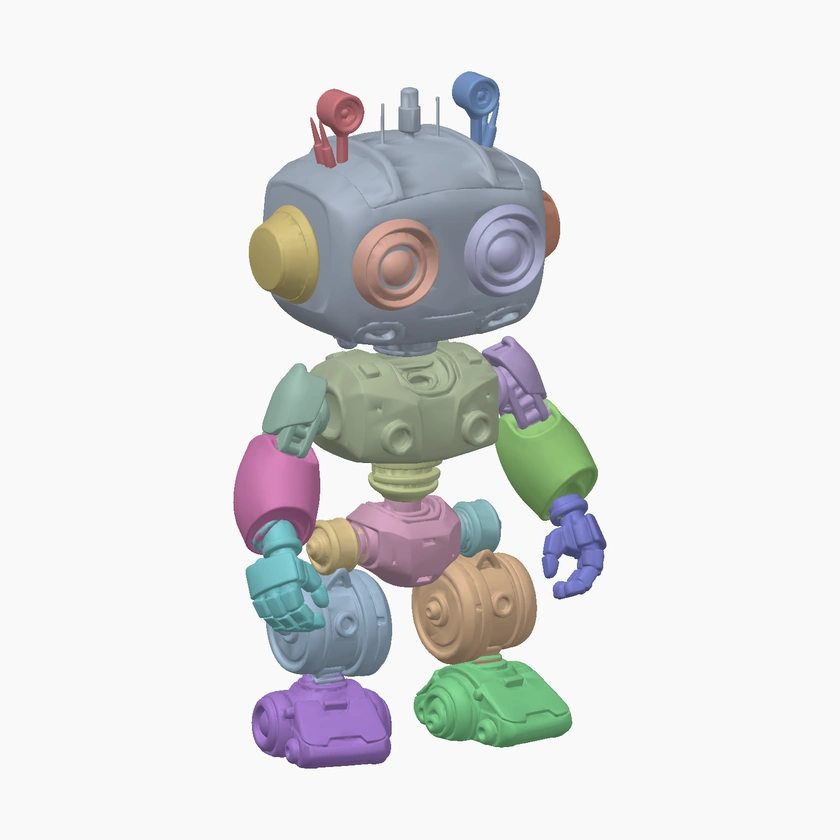
Choose an object to explore PartAgent’s final segmentation. Each color marks a different part.

Compare part segmentations

Each row shows the same object from the same viewpoint and at the same scale across all five methods.

Scroll sideways to compare all five methods.

SAMPart3DPartFieldP3-SAMPartSAMPartAgent
Decorative fish segmentations, from left to right, by SAMPart3D, PartField, P3-SAM, PartSAM, and PartAgent.
Decorative fishPartAgent keeps the dorsal and tail fins as one part each.
Water well segmentations, from left to right, by SAMPart3D, PartField, P3-SAM, PartSAM, and PartAgent.
Water wellPartAgent separates the roof fittings and segments the roof surface and stone wall as one part each.
Wooden chest segmentations, from left to right, by SAMPart3D, PartField, P3-SAM, PartSAM, and PartAgent.
Wooden chestPartAgent separates the lid from the body and keeps the handle and latch distinct.
Decorative hammer segmentations, from left to right, by SAMPart3D, PartField, P3-SAM, PartSAM, and PartAgent.
Decorative hammerThe shaft forms a single part, distinct from the head and end cap.
Lidded bucket segmentations, from left to right, by SAMPart3D, PartField, P3-SAM, PartSAM, and PartAgent.
Lidded bucketThe lid, handle and body are separate parts.
Suspended chandelier segmentations, from left to right, by SAMPart3D, PartField, P3-SAM, PartSAM, and PartAgent.
Suspended chandelierThe outer rim forms one part, separate from the suspension rods.

Benchmark results

Mask Match mIoU (%) pairs each ground-truth part mask with its best-matching predicted candidate mask. Scores are averaged over objects. Higher is better.

PartObjaverse-Tiny-WT

Scores by category. Overall averages across all 200 objects.

MethodHumanAnimalsDailyBuild.Trans.PlantsFoodElec.Overall
Find3D24.5823.1924.0014.6912.7223.0629.9618.4919.90
SAMPart3D60.3970.7363.0350.5951.7865.1870.5358.3359.53
PartField61.5465.8369.1947.8348.7965.3673.3162.7759.88
P3-SAM59.6557.6861.6042.9949.6556.5664.4755.2254.85
PartSAM54.9361.1056.4740.9748.7461.8549.3853.8053.12
PartAgent70.9771.0070.9256.4062.9375.4078.0071.6168.41

PartAgent leads the strongest baseline, PartField, by 8.53 points overall.

Four additional benchmarks

The mean gives equal weight to the four dataset scores.

Method3DCoMPaT200PartNeXtPartNetEPartObjaverse-TinyMean
Find3D32.2133.5922.5421.4727.45
SAMPart3D55.1659.2654.4954.3355.81
PartField60.7066.0163.3258.2762.08
P3-SAM51.8059.7959.6355.2256.61
PartSAM57.3462.2354.9765.5860.03
PartAgent67.8272.4271.4365.7669.36

PartAgent leads the strongest baseline, PartField, by 7.28 points on the four-dataset mean.

BibTeX

@article{cao2026partagent,
  title = {PartAgent: Agentic 3D Part Segmentation via Expert Integration and Closed-Loop Refinement},
  author = {Cao, Yang and Zhu, Zhe and Zhang, Yiheng and
            Zhang, Zhengqiang and Li, Haoyuan and Wan, Le and Xu, Dan},
  journal = {arXiv preprint arXiv:2611.32554},
  year = {2026}
}